
Growing Your Nonprofit’s Online Giving Through Storytelling
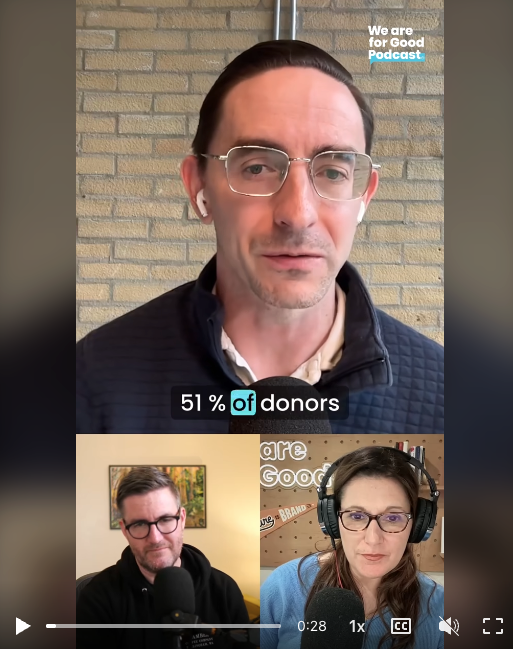
Here's a stat that stops me in my tracks every time I share it: 51% of donors research causes and charities online before making a donation. And yet more than 50% of nonprofits don't have a clearly defined digital marketing strategy.
We call that the digital donor gap.
On a recent episode of the We Are For Good podcast, I had the privilege of sitting down with hosts Jon McCoy and Becky Endicott for a Working Session dedicated to one of the most asked questions in the nonprofit space right now: How do we grow online giving?
I want to recap what we covered, because I think the conversation went somewhere unexpected. And honestly, that's what made it good.
It's Not a Silver Bullet. It's a Relationship.
Before we get tactical, let me level set.
When nonprofits come to us, they often arrive with urgency. "We need to grow our online giving. We need to do this, this, and this, tomorrow." I get it. The pressure is real. But I always want to pause and remind people: digital marketing is not a silver bullet. At the end of the day, everything we do online is rooted in human relationship.
Brian Stevenson says proximity breeds empathy. I believe that. And I think one of the biggest challenges in our culture right now is that we're becoming less and less physically proximate to each other. So everything we do in the digital space should ultimately lead your community to take physical action in the real world.
The channel is digital. But the person on the other side is a distracted human with a hundred other things going on — their wallet is in the other room, their notifications are pinging, their attention is split. Our job is to break through that and move them toward real relationship and real action.
Start With This Exercise (Seriously, Grab a Pen)
Before you look at your ad spend, your email open rates, or your website traffic — do this:
Write down the name of someone in your organization's primary programming role, and the name of someone in your development or fundraising role. If you're a smaller org, write down the name of a service recipient and the name of a donor.
Now go talk to them.
Marketing lives too often in a silo. We're looking at screens and spreadsheets when we should be listening to the people closest to the mission and the money. When you understand how someone experiences your impact — and why they give — you now have raw material for authentic storytelling. That's your content. That's your strategy.
I make this a regular rhythm. And I'd encourage you to do the same.
The Framework: Feel → Know → Do
Once you have those inputs, everything we create runs through our storytelling framework:
What do we want our audience to FEEL?
What do we want them to KNOW?
What do we want them to DO?
This isn't just a creative exercise. It's a filter. Every email, every social post, every campaign — if you can answer those three questions, you're telling a story that moves people.
The Digital Growth Framework: Awareness → Consideration → Action
Here's how the storytelling framework maps to your digital channels:
Awareness — Organic social media and paid advertising. This is how you get in front of new people and stay visible with your existing community.
Consideration — Website conversion optimization. Once someone lands on your site, is it clear what you do, who you serve, and how they can get involved? This is where so many organizations leave donors behind.
Action — Email marketing and marketing automation. Once someone takes a desired action — signs up, donates, clicks — what happens next? Your nurture process is everything.
Think of it as a funnel, and make sure you're investing intentionally in each stage. That's how you set goals, too — not just at the donation level, but at each step of the journey.
Where to Start If You're Overwhelmed
If you're wearing multiple hats and wondering where to focus first — start with email.
Email is where you build what's called first-party data: names, email addresses, direct contact information. Unlike third-party cookies or social media algorithms, you own this. It's your most reliable channel for deepening donor relationships.
Start simple. Set an attainable goal for how often you'll show up in people's inboxes. Once a month is fine. Then build from there — segmenting by donor behavior, personalizing by interest, and eventually automating parts of the journey.
Don't start with the appeal. Start with the relationship.
An Example: Building Community First, Growing Giving Second
We're currently working with an organization that has 1,800 people on their email list. Instead of hitting that list with donation appeals, we redirected the main call-to-action in their newsletters to become what we call Insiders — a private community inside Basecamp where donors, subscribers, and partners get exclusive updates and can actually talk to each other.
In a short time, 180 people joined. Engagement is through the roof. The executive director is giving behind-the-scenes updates. People are connecting not just with the org, but with each other.
The online giving? We believe it's coming. Because we're building something real first.
Play the long game.
What High Conversion Actually Looks Like
For organizations that have played that long game with us, we're seeing 20–40% conversion rates on email appeals. That's not a typo. The industry average is a fraction of that.
Here's the approach: 60–75% of your emails should just tell stories. What's the impact of a gift? What did your organization accomplish this month? Who was helped, and how?
Then, when the moment is right, you make the ask — specific, human, and tied to a tangible outcome. "Will you be a part of this? $50 provides a refugee with meals for a month."
That's what we're going for. Not every email is a pitch. But every email is building toward one.
Free Resources for You
If anything in this resonated, I want to put two tools in your hands:
An email campaign calendar — so you can map out where your stories land throughout the year and where you can choose your moments for appeals.
A Growth Tracker — a spreadsheet to help you track key metrics, audit where you are today, and set goals for growth.
Just email me: josh@sparkcollective.net and I'll send them your way.
One Good Thing
The one thing I'd leave you with is this: get out of your comfort zone and go talk to someone.
Nonprofit marketing has pushed me — an introvert — to have conversations I would have avoided. And every single time, I walk away with something that makes my work better and more human.
Marketing is just storytelling. Storytelling requires knowing people. So go know some people.
And if you're in the middle of a late night, wondering whether any of this is working — keep going. The fruit is there, even when you can't see it yet.
Want to explore what a digital growth strategy could look like for your organization? Schedule a free clarity call with Spark Collective.
Listen to the full Working Session on the We Are For Good podcast.